Ad (728x90)

Showing posts with label nowiknow. Show all posts

Saturday, 14 November 2015

Why do we always colour the Sun yellow?


The Sun, as we all know, is a main sequence white star. It is glowing white hot at the centre of our solar system. Well, it is being called the Solar System for this same reason!

Almost all representations and paintings of the sun are made in yellow colour. Even we ourselves draw it as such. As far as I have read, it has only been a discussion topic in the net quite recently.

There are many possible reasons why we yellow it:
  •  The only time when the sun can be comfortably viewed with the naked eye is during the sunset/sunrise. The sun assumes a comfortable candy yellow colour this time due to scattering. Hence that became the standard colour.
  • We were usually given white papers to draw sceneries in our kindergarten years. To make the sun appear bright on such a white background, yellow became a good choice.
  • The appearance of sunlight as yellowish due to scattering of blue wavelengths in the sky.
  • Some comparison of egg yolks with the sun (as in the phrase "sunny side up.")

As per Yahoo answers, the first point seems to be the more reasonable one. 
A typical cartoon Sun

A more natural depiction of sun
Sun in the usual yellow.
Real Sun. Note that filters are applied here to make more subtle features visible.
Real Sun as visible on a clear sky.


nowiknow

Cat cafés!!!

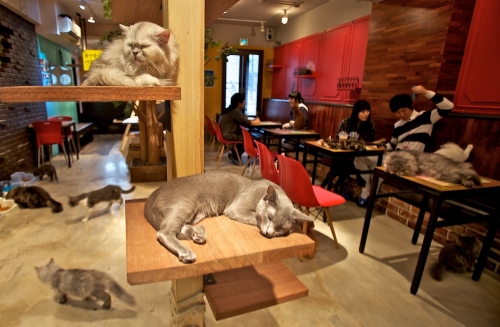
Cat cafes are special psychology clinics that contain only cats! The main attraction of these places is cats and customers are usually charged at an hourly basis.

So what makes these establishments popular? In places like Japan and Taiwan (where the concept took place in 1998) living apartment areas tend to be small and thus people may find it hard to house a pet with them. A place specially dedicated to pets are thus quiet convenient.

Cats are naturally lonely animals; they can look after themselves and are easier to feed than dogs. Not to mention their quietness. All these cafes have to strictly comply with animal welfare and protection laws as applicable to their home countries. They are protected from over attention and abuse by young children and cats are scientifically accommodated based on available floor areas. They are usually adopted from a young age so that they don’t exhibit shy or aggressive behavior towards the patrons.

Some cat cafes in Japan specially featuring black cats, fat cats, rare breed cats, ex-stray cats etc. The latter also keeps the population of stray cats in check.

But why only cats are preferred? From companionship to heart health, there are certain health benefits to humans that can only be completed by petting a cat!

It is believed that the temple of Bastet (cat god) of ancient Egypt may have been a cat cafe complete with a large idol of Bastet and, since it is ancient Egypt, the temple itself built out of gigantic proportions; because why the hell not? It is better to spend extravagantly on something you really adore than something you don’t care.

nowiknow

Sunday, 4 October 2015

Slums other than Dharavi that you might not heard off.

Do you think only India have slum settlements then i think you are wrong. Take a look to below settlements and you might change your mind.

Rio de Janeiro, Brazil


Rio De janerio is one of the huge sea side tourist attraction in Brazil known for Copacabana and Ipanema beaches, 38m Christ the Redeemer statue atop Mt. Corcovado and Sugarloaf, a granite monolith with cable cars to its summit. But it also has one fifth of the city's population  living in slums which also called Favelas. It was inhabited in 1800s by soldiers and their families along with former slaves.

Phnom Penh, Cambodia


Slum locations — defined by the government as informal settlements erected on state public land — increased by eight to 511. In total, just over 25,100 families reside in Phnom Penh’s slums.

Cairo, Egypt


Cairo is home to a few famous slum neighborhoods, including Ezbet el-Haggana and City of the Dead. Ezbet el-Haggana purportedly has a population of over one million people. City of the Dead is a necropolis and cemetery located in southeastern Cairo where many ancient corpses are buried.

 Kibera, Kenya


Kibera is a slum neighborhood of Nairobi and the largest urban slum in Africa. Like Dharavi in India, the good neighborhoods are mainly occupied by Europeans, while the slums are inhabited by Africans and non-European immigrants. A diverse neighborhood, Kibera has been home to various ethnic conflicts. The Kenyan government effectively ignores Kibera, providing it with no schools, running water, or basic services.

Libertador Bolivarian Municipality, Venezuela

Photo by: fraymifotovia Flickr

Libertador Bolivarian Municipality is an area of Caracas in Venezuela with a population of over two million. Although many important political buildings are located there, it is also one of the world’s largest mega-slums. This is likely due to the unexpected boom in migration of job-seekers to the area in the 1960s and 1970s.

Orangi Town, Pakistan

Photo via: TinyPic

While Orangi Town, located in the city of Karachi, is considered to be the largest slum in Asia, only some parts of it meet the actual definition of a slum. It was a significant squatter settlement in the 1960s, which meant it went largely ignored by the government in terms of municipal development. The Orangi Pilot Project, which started in the 1980s, significantly improved the living conditions and amenities available to Orangi residents.

Bogotá, Colombia

Photo by: Istvan Reznekvia Flickr

Bogotá, Colombia’s capital, has seen its fair share of violence due to gang, mafia, and terrorist activity. The surrounding area is quite rural and mountainous, but the urban part is one of the world’s largest mega-slums.

Santo Domingo, Dominican Republic

Photo by: Matt Hintsa via Flickr

Santo Domingo is the oldest continuously inhabited European settlement in the Americas. Today, one third of the population of the Dominican Republic lives in Santo Domingo, 65 percent of which live in slum neighborhoods.

Manila, Philippines

Photo by: Max McMillan via Flickr

In the slums of Manila, there is an enormous pile of garbage 50 meters high called Smokey Mountain. The entire thing is probably about two million tons of garbage. People who live in the area make a living by picking up garbage and finding recyclables that they can sell.

Neza-Chalco-Iza, Mexico

Photo by: Heraldo de Toluca via Flickr

Neza-Chalco-Iza is a combination of municipalities in the Mexico City metropolitan area that comprise the world’s largest mega-slum in 2006. Many residents do have access to basic amenities, but the quality of these amenities is questionable, and the area is also very poverty and crime ridden.

Lima, Peru

Photo by: zug55 via Flickr

On the outskirts of Lima, there is a large conglomeration of shanty towns nicknamed pueblos jóvenes. Many of the houses aren’t really houses at all, but rather worn-down shacks, many of which lack running water and electricity. These little towns have turned into significant districts that make Lima the fourth-largest city in the Americas.

Accra, Ghana

Photo via: Cookie Sound

Waste collection, water, and electricity services have not been able to keep up with the recent explosion of immigration to Accra, resulting in the development of many large slums. The fishing communities of Jamestown and Usshertown are the oldest districts of Accra. They receive a relatively large amount of tourism despite the general squalor of the area.

Monrovia, Liberia

Photo via: Go International

Monrovia, the capital of Liberia, is located on the Atlantic coast of the country. West Point is a township of Monrovia that lies on a peninsula, and it also happens to be one of Monrovia’s largest slums. Because of its location on a peninsula, there has been a lot of degradation in the area as it slowly erodes into the ocean.

Windhoek, Namibia

Photo by: senfi via Panoramio

Otjomuise, a township in Windhoek, derives its name from the hot springs in the area. The housing largely consists of makeshift shacks made of sheet metal with no amenities like running water and toilets.

Cape Town, South Africa

Photo via: Andrew Rabatin

Joe Slovo is an informal settlement in the town of Langa, a suburb of Cape Town. It was named after activist Joe Slovo, a man who contributed to the fight to end apartheid. There are many other informal settlements with the same name in South Africa, but with a population of about 20,000, the one in Langa is the largest.

Dhaka, Bangladesh

Photo via: Will Go To

Begunbari is a slum in Dhaka, Bangladesh where residents live in hundreds of shanties. In 2012, it was ravaged by a fire, leaving a majority of the residents homeless.

Hong Kong, China

Photo via: 8 things to do

Kowloon Walled City was originally a military fort in Hong Kong, but turned into a densely populated settlement. In 1993, the Hong Kong government began evicting residents and demolished the neighborhood over the next year. The settlement was replaced by Kowloon Walled City Park, which displays artifacts from the city.

Cité Soleil, Haiti

Photo via: Pursued by God

Cité Soleil is a shanty town in Haiti with a very young population. Residents are plagued by extreme poverty, violence, and disease (the sewage system is a series of open canals). It is considered to be one of the poorest and most dangerous areas in the Americas.

20. Hidalgo County, United States

Photo via: Best on Top 10

In the south of the United States, colonias are unregulated informal housing settlements with poor sanitation, poorly-constructed roads, and a lack of potable water. Hidalgo County is a representative example of these colonias. It began as a settlement of Mexicans looking for farm work in the United States, but was quickly exploited by wealthy landowners. Today, many people in Hidalgo County live in a slum, and 50% live below the poverty line.

21. Melbourne, Australia

Photo via: Wikipedia

Shortly after Melbourne was founded, many red light districts formed, characterized by prostitution and petty crime. One such district is the Little Lon district, which was home to many brothels, cigar shops, and houses occupied by prostitutes. Since then, the district has risen out of its slum status and lost much of its former notoriety.

Havana, Cuba

Photo via: Translating Cuba

There are a few shanty towns in Havana, but most of the city’s slums are concentrated in the Old Town. Many people live in solares, which is a large mansion or hotel turned housing unit for up to 60 families.

Belgrade, Serbia

Photo via: Wikipedia

Another notorious slum that has since been eradicated is Cardboard City in Serbia’s capital of Belgrade. All of the houses were constructed with poor-quality materials such as cardboard, plywood, and nylon bags. The settlement was evicted in 2009 after three unsuccessful previous attempts by the city government.

Madrid, Spain

Photo via: NPR

The largest shanty town in Western Europe is located in Spain’s capital of Madrid. The area is characterized by violence due to the local drug gangs.

Istanbul, Turkey

Photo via: Total Fascism

Sultanbeyli began as a village built on farmland. It currently has a population of over 250,000 people.

San’a’, Yemen

Photo via: Biyokulule

In Yemen’s capital of San’a’, there is a slum community called Mahwa Aser. In July 2008, violence erupted in Mahwa Aser as police invaded the community and tried to evict residents, resulting in the destruction of about ten homes.

El Mina, Mauritania

Photo via: Asharq Al-Awsat

El Mina is unfortunately known for its poverty and prostitution, giving it a bad reputation. Many of the 95,000 inhabitants are the descendants of slaves.

Bangkok, Thailand

Photo by: Wordcat via Flickr

The Khlong Toei District is an infamous slum neighborhood in Bangkok, Thailand. Despite this, it is also a port along the river and the site of a major market.

Manchester, England

Photo by: Fernieworks via Flickr

In the early 1800s, Little Ireland was a slum district in Manchester populated largely by poor Irish immigrants. The slum conditions didn’t last very long, however, because in the 1840s, residents were evicted and the district was demolished in order to make way for a railway line. During its short life, Little Ireland was an example of a typical Irish slum in industrial England.

Kinshasa, Democratic Republic of the Congo

Photo via: BBC

The wealth gap is highly apparent in Kinshasa, the capital of the Democratic of the Congo. Affluent families and universities live along the river alongside poverty-stricken slums.
nowiknow

Monday, 28 September 2015

What is the dark side of the Moon?


To tell the truth there is no dark side of the moon. Even though we always see the same side of the moon it doesn't mean that the other side always stays in the dark. People say to mystify the moon that 'It has the dark side which we will never see.'

'We will never see' part is true from the perspective of a person who is on earths surface but the 'Dark side' part is a pure myth. Moons other side does not always stays dark. But why we can see only one side of the moon from earth? It's because the speed at which moon rotates has led to this particular phenomenon. Millions of years ago moons rotational speed was much faster but the gravitational influence of the earth slowed it down much like moons gravity effects the tides in the ocean.

This influence led to slowed rotation period of of the moon to match that of its orbit which is 27.3 days. Lets say if the moon didn't spin at all then it would have eventually shown its other side to the earth while moving around earth in orbit. But since moons rotational period is exactly the same as the orbital period, the same portion of the moons sphere is always visible to earthlings.

The other side of the moon is referred to as the dark side because many people mistakenly thinks that the other side never receives light from the sun. And the fact is that the moon is rotating on its own axis and there is no area on our moon which is permanently dark.


nowiknow

Sunday, 27 September 2015

Super Samurai of Japan!


When we think about super heroes the first thing that comes into our mind is super human abilities. There are very few persons in the world who has the gift of super human abilities. One of them is Isao Machii.

Isao Machii is a Japanese citizen and an Laido Master. Lives in Kawanishi, Hyogo, Japan. He holds many Records is Guinness World Records. Dr. Ramani Durvasula saw him cut a pellet from a BB gun in half and said these words.
"This is about processing it at an entirely different sensory level because he is not visually processing it. This is a different level of anticipatory processing. Something so procedural, something so fluid for him."
This indicates and extraordinary level of perception and reaction expected from a human. The size of pellet is less than 4.5 mm. If you want to cut this pellet on a chopping board without holding it, is a big challenge yet alone when fired from a BB gun.

Is this Genetic or honed skill, I believe he is just as human as we are but with much more determination in whatever he does. it's a honed skill through years of practice and persistence. I have to say his powers are not gift but it is an earned ability.


nowiknow

Wednesday, 23 September 2015

Top 7 Red Light Areas in India

In India prostitution is not exactly regulated but it is illegal to solicit in a public area, kerb crawling, owning or managing a brothel, prostitution in hotel and pimping or pandering.One of the oldest trade in India or lets say all over the world is prostitution. It's not just human behaviour but show by many other species like penguins(they do prostitution for stones.).

'Nagarvadhu' was an ancient concept in India. The word itself means 'the bride of the city'. The most beautiful woman in the city was chosen as nagarvadhu. This post was very prestigious and the chosan women was treated like queen. The main job of a nagarvadhu was being a courtesan or prostitute but only available to kings, princes and rich classes of the ancient Indian society.

These below given areas are said to be the den for prostitution where some do prostitution for money, some are forced into it by situations.

7. Chaturbhujsthan, Muzaffarpur

One of the most populated city in Bihar and has an old temple accompanied by the biggest red light area in north Bihar.


6. Shivdaspur, Varanasi


A red light village in Varanasi famous for its prostitution works and also cheap brothels. Most of them being run from homes in villages. Varanasi was known for its Tawaif culture. This area is situated in UP and just ten minutes away from Varansi railway station. Many Ngos are active here saving children from going into prostitution.


5. Ganga Jamuna, Nagpur

In the heart of the orange city of India famous for Nagpur oranges lie one of the most notorious red light areas in Maharashtra state. This Area is not only famous for prostitution but also all sorts of criminal activities.


4. Budhwar Peth, Pune
Pune is one of the biggest city in Maharashtra state. When comes to shopping of electrical goods and electronics items people prefer Budhwar Peth. It is also famous for large population of sex workers. no matter what you want to buy cheap or expensive sex you end up at the same place.


3. Kamathipura, Mumbai
Mumbai one of the mega cities in the world having the largest slum in the world 'Dhravi' also famous for Bollywood Production Houses. This city is called the financial capital of India and as well as city of dreams and infinite opportunities. There is something which is famous 'Kamathipura' Asia's second largest red light area. Most dangerous part of Mumbai where crime rate never comes down.


2. G.B. Road, Delhi

Delhi capital of India also contain so called red light area known for hundreds of brothels along the streets of 'Dilwalon Ki Dilli'. There are many multi storied building wher the ground floors act as shops and rest acts as brothels. This area accounts for majority of cases for Minor prostitution.


1. Shonagachi, Kolkata

When You hear Kolkata you first may think about Rashogulla a signature Bengali Sweet. But it is also place where the Asia's  largest red light area exists place for 11,000 sex workers. It was well described in the oscar winning documentary 'Born into Brothels'. It is situate along the banks of Ganga which is considered to be a holy river. Not to be surprised it is also infamous for Crimes.


Let me know your thoughts on this subject. Comment Please.


nowiknow


Copyright © Talented Jobless ™ is a registered trademark.
Designed by Templateism . Hosted on Blogger Platform.